July 27, 2026

Somewhere around October, a leadership team will sit down and agree on next year’s revenue target.
It will be ambitious. It will feel achievable. And it will probably be set without anyone in the room connecting that target to the pipeline, budget, capacity, and calendar required to deliver it.
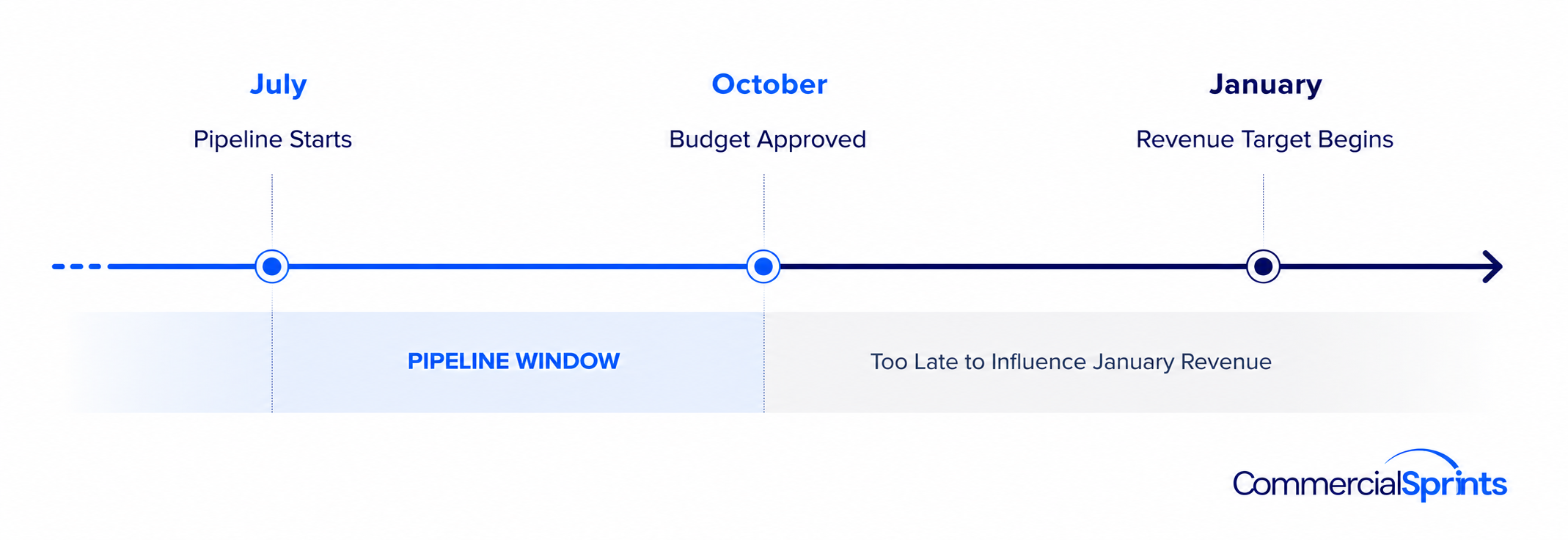
By January, the revenue target is in effect.
The pipeline to deliver it is not.
The cause sits in the planning calendar rather than in the team. Most companies with sales cycles longer than a few months are set up, by their own planning dates, to start the year behind.
The longer the cycle, the more damaging the problem becomes. Every month of sales-cycle length removes another month in which the company can recover during the year.
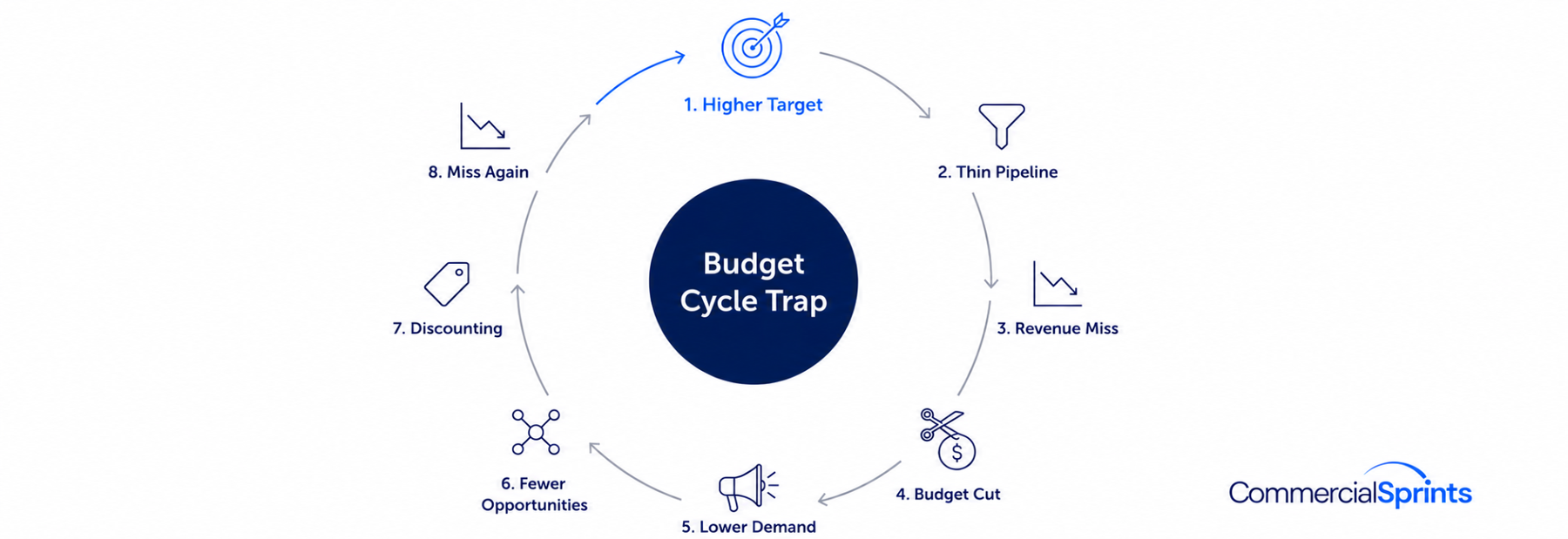
This is the Budget Cycle Trap.
Once you see it, you begin to recognise it in budget meetings, pipeline reviews, mid-year cost cuts, and every frustrated January sales kickoff where the team is asked to close a gap that was created months earlier.
I have walked dozens of leadership teams through the pattern. First a slow nod. Then a glance across the table. Then someone says: "That is exactly what happens here." The idea is simple. It stays unnamed in most companies because the symptoms look like performance problems and the cause has no single owner.
Three clocks that do not line up
You know that scene in a film where a team is preparing a critical operation and the leader says: “Set your watches.”
Everyone synchronises. The plan works because every person and every step runs on the same clock.
Now play the scene again with each watch set in a different time zone.
They all check in, confirm and proceed. But nothing lines up.
From where each person stands, they are exactly on time.
That is a commercial year in most companies.
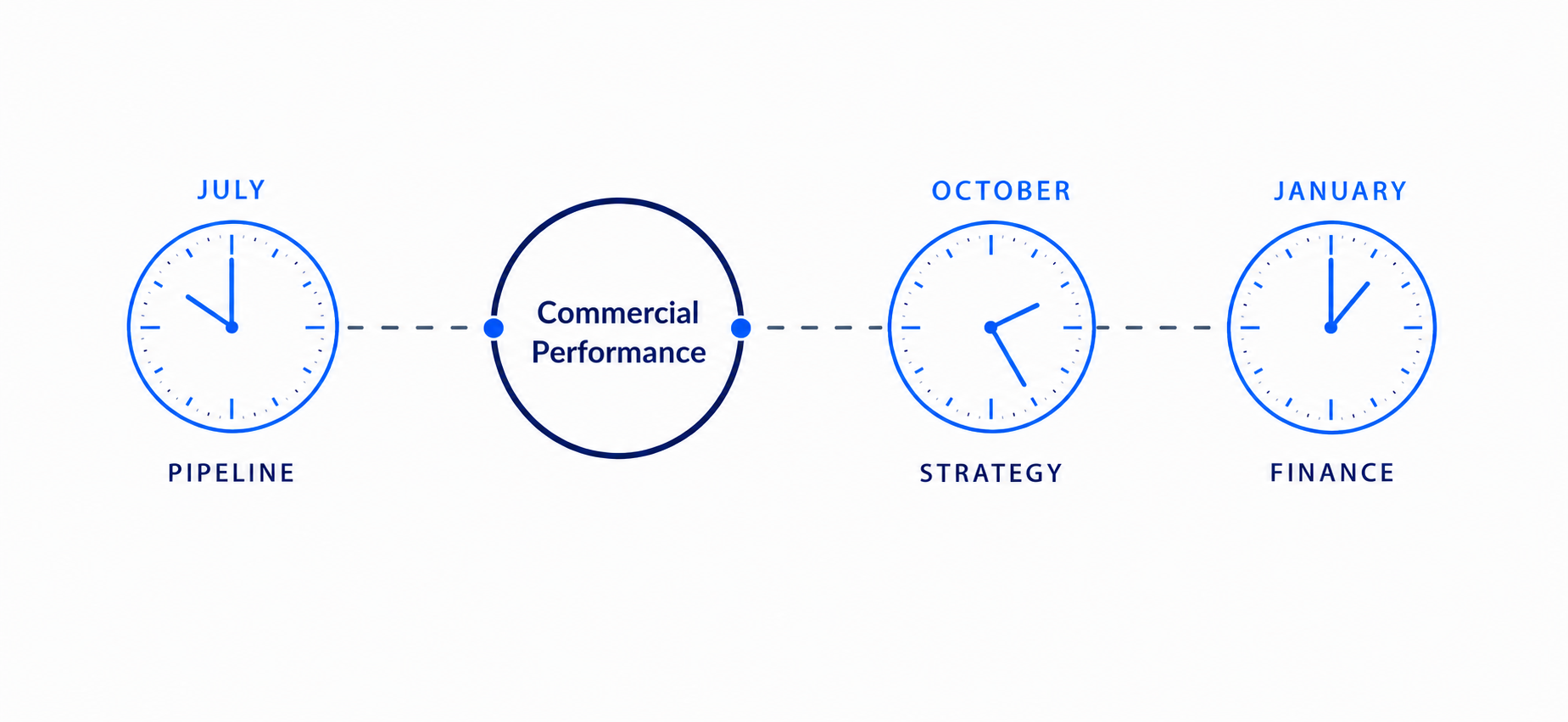
Three clocks are running.
The strategy clock sets the target.
The board agrees on next year’s revenue target during the autumn, often materially above the current year, and it takes effect in January.
The pipeline clock builds the opportunities that must deliver the revenue.
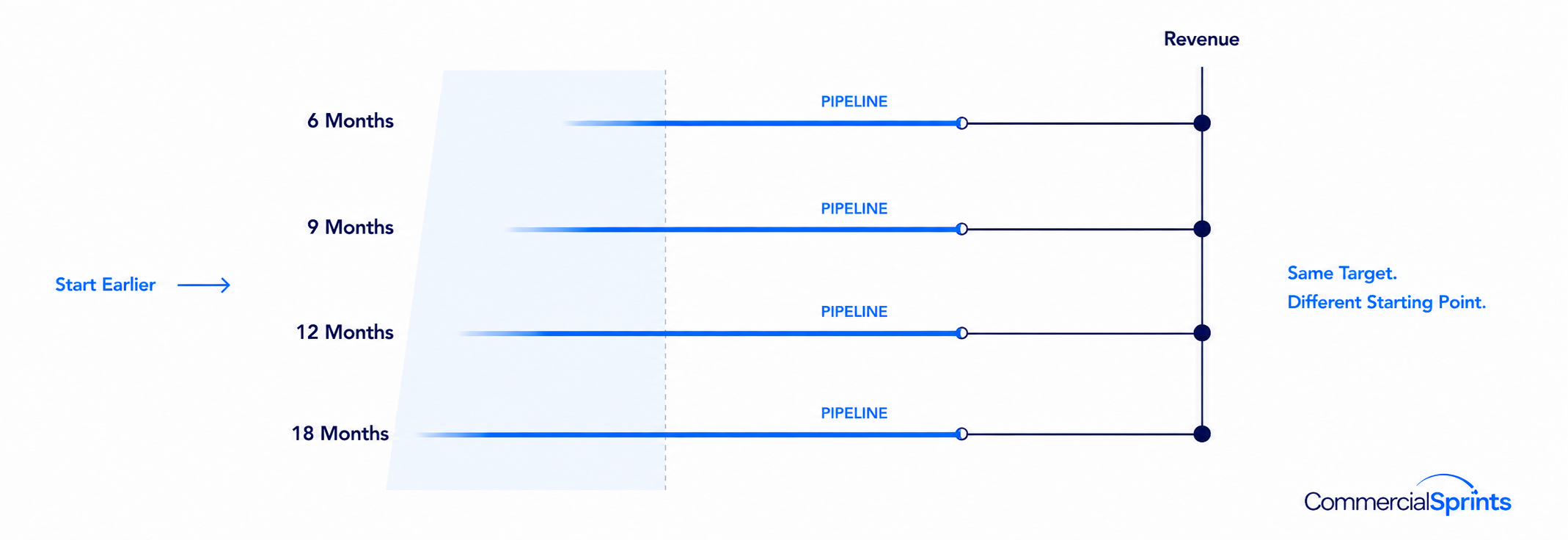
With a six-month sales cycle, the pipeline needed to produce January revenue had to start building in July, months before the new target existed. For businesses with nine, twelve, or eighteen-month cycles, it needed to start much earlier.
But in July, next year’s target may not yet exist. Sales and marketing are still focused on closing the current year because that was the plan they had.
The finance clock funds the work.
The marketing spend, the team capacity, the travel, the tools. Those budgets were fixed during last year's planning cycle, based on a different and often smaller ambition, and if this year fell short of plan they have probably been cut already. Marketing and other discretionary commercial investments are among the easiest lines to cut when leadership needs to protect margins, cash, covenants, or shareholder expectations.
The budget aligned with next year’s elevated target does not begin until the new fiscal year.
Three clocks.
Three legitimate management processes.
Three calendars that were never synchronised.
And every January, the company discovers that it is starting behind.
Again.
Follow the loop once
The Budget Cycle Trap becomes clearer when you follow the cycle.
Each step appears reasonable on its own.
Everyone in that loop may be acting rationally within their own remit.
The board set direction, leadership protected the bottom line, marketing worked within the resources available, and sales fought for what was there. The company still missed.
That is what makes the trap so persistent. The frustration lands on people, but the cause sits between functions, calendars, and planning cycles.
The Budget Cycle Trap is rarely the only cause of a miss, but it can amplify problems in sales execution, pricing, retention, product fit, and market conditions.
Why the trap survives
The Budget Cycle Trap survives because it is largely invisible in normal reporting.
Periodic business reviews report on the period in progress. They examine revenue, cost, pipeline coverage, deal progression, and the likelihood of closing the quarter or year.
What they usually do not cover is whether the pipeline needed to secure next year’s revenue is already being created. The organisation reviews the year in progress, but rarely tests whether the next year is already being built.
The symptoms surface everywhere: thin pipeline, slow starts, mid-year cuts, and discounted deals. The cause sits between three calendars that the standard review does not connect.
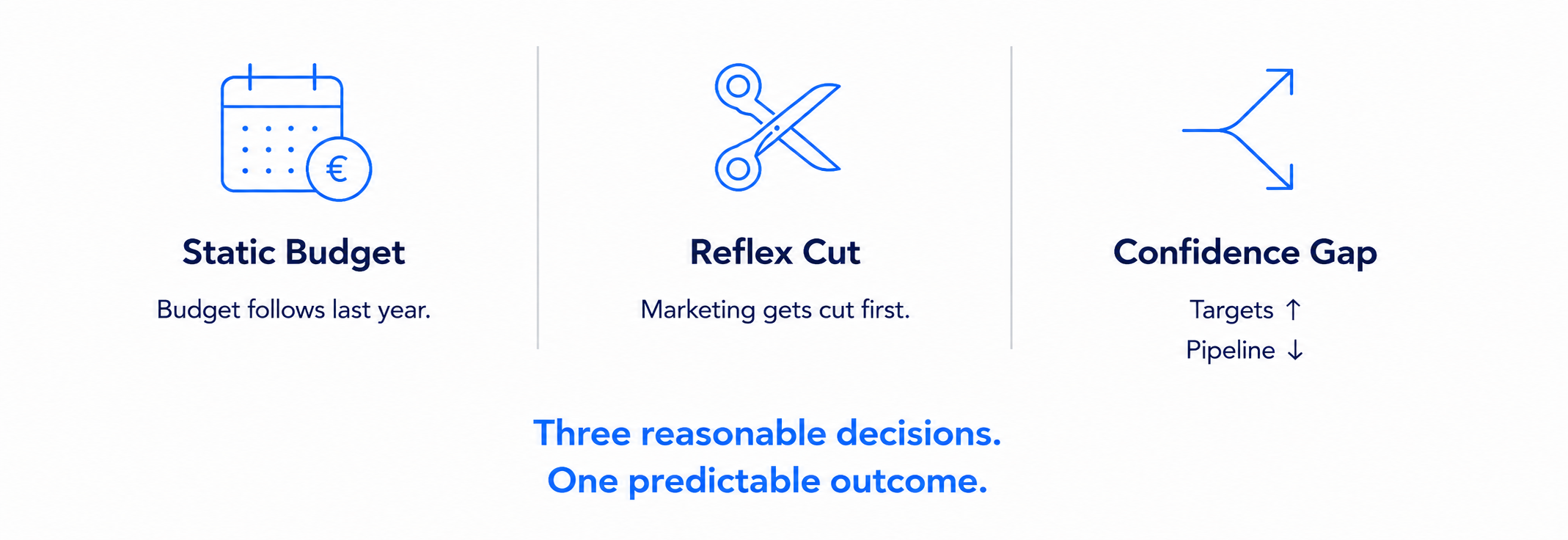
Three habits keep it running.
The static budget. Only about a third of companies say their budget actually reflects their strategy, and year to year, spending barely moves even when targets rise (McKinsey).
The reflex cut. When the year falls short, marketing is often among the first areas reduced, although it helps build the pipeline the following year depends on. Companies that cut it under pressure risk handing up to 15 percent of their business to competitors who keep investing (Analytic Partners).
The confidence gap. Around 91 percent of executives say they are confident of hitting their growth targets, while the share who miss keeps growing (Bain). Confidence in the autumn and pipeline in January are two different assets.
Meanwhile, the pipeline is slowing
B2B cycles have lengthened by around 38% since 2021 (EBSTA). Buying committees have become larger. Internal decisions take longer. Buyers conduct more research independently and increasingly use AI tools, peer networks, and digital sources before speaking with suppliers.
They arrive later, leave fewer visible signals, and involve more stakeholders.
The implication is straightforward.
Pipeline must be built earlier and more deliberately.
Yet the investment required to create that future pipeline is often the first thing reduced when the current year disappoints.
The company protects the present by weakening the future.
Reverse the calculation
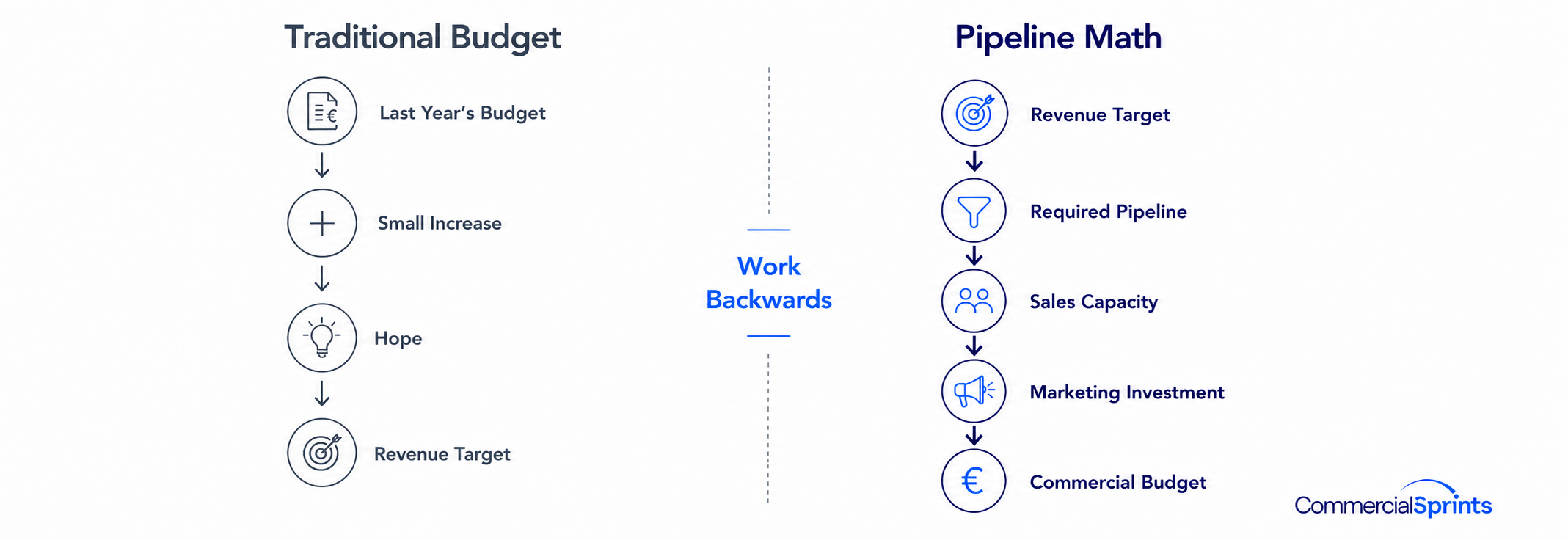
The way out is to stop building the commercial budget forward from last year and start building it backward from the target.
I call the discipline Pipeline Math: take each year of the growth plan and work backward through your own deal economics, conversion rates, sales-cycle timing, and commercial capacity. The calculation reveals what pipeline must exist, by when, and what the organisation must fund and execute to create it.
That becomes the commercial budget: the price of the target rather than a number to negotiate down.
The formula fits on a page; the work is in what you feed it and in getting sales, marketing, and finance to accept the same answer.
For most companies, next year’s first-half revenue depends heavily on pipeline that must be funded and developing during the second half of this year.
Not in January.
Now.
A target without a credible pipeline plan, sufficient capacity, and a timeline that reflects the sales cycle is not a plan.
It is an ambition with a calendar attached.
Pipeline Math changes the budget discussion.
Instead of asking:
“How much can we afford to spend?”
Leadership asks:
“What must be true for us to hit this target, and are we funding and managing those conditions early enough?”
The first question controls cost.
The second manages growth.
One year may already be too late
For companies with longer sales cycles, working backward from next year’s target may still be too narrow.
By the time the target is finalised, much of the relevant pipeline-development window may already have passed.
The answer is a rolling two or three-year growth model in which forward pipeline requirements are reviewed alongside current performance.
This does not require another static long-range plan.
It requires leadership to keep the assumptions behind the growth plan current and to test whether the business is building the pipeline needed for future periods before those periods begin.
The autumn budget cycle then becomes a recalibration exercise, rather than the moment the company first discovers what next year requires.
Break the Budget Cycle Trap
Breaking the trap requires the target, pipeline, budget, capacity, and calendar to run as one commercial plan.
That is what Pipeline Math is designed to do. We work with leadership teams to reverse-calculate the pipeline their growth plan requires, expose the gaps early, and align sales, marketing, and finance around the same assumptions and timeline.
Before the next budget discussion, ask one question:
Does your company have a funded and resourced pipeline plan built to the same number and timeline as its revenue target? Or are the target, budget, and pipeline still running on different clocks?
Set the clocks before your pipeline window closes.
What is the Budget Cycle Trap?
The Budget Cycle Trap occurs when the revenue target, commercial budget, and pipeline-development timeline are set through different planning cycles. The new target takes effect in January, while the pipeline needed to deliver it may have required funding and development months earlier. The company therefore starts the year behind, even when each function acted reasonably.
Why do companies start the year with too little pipeline?
In companies with longer sales cycles, early-year revenue depends on opportunities that should have been created and qualified during the previous year. However, the target may not yet have been finalised, and the available commercial budget was often based on an earlier, smaller ambition. If spending was cut during the year, the pipeline gap becomes larger.
What is Pipeline Math?
Pipeline Math starts with the growth target and works backward through the company’s deal economics, conversion rates, sales-cycle timing, and commercial capacity. It determines what pipeline must exist, by when, and what the organisation must fund and execute to create it. The resulting budget becomes the price of the target rather than an incremental adjustment to last year’s spending.
When should a company start planning next year’s pipeline?
The relevant date depends on the sales cycle. A business with a six-month cycle may need to begin building next year’s first-half pipeline by the middle of the current year. Companies with twelve- or eighteen-month cycles need a longer planning horizon. The calculation should begin before the pipeline window required by the target has closed.