September 3, 2026


You can already picture the annual sales kickoff. A bigger revenue target goes up on the wall with a fresh set of slides. Everyone in the room can see the gap between the pipeline in the CRM and the number the team has just been handed. The room is told to go and close it. Within weeks the gap is confirmed: the pipeline needed to deliver the first half of the year should have been built last year. That gap opened months before anyone in the room saw the number.
In two-thirds of companies, individual sales quotas are communicated after the fiscal year has already started (Korn Ferry). Often that number is a significant departure from the bottom-up figure the commercial team built during the budget cycle, a figure that did not survive the board. You are accountable for a figure that may look nothing like the one you planned against, and the pipeline was never built for it.
When the year falls short, the marketing budget, one of the few discretionary lines leadership can adjust mid-year, gets cut to protect this year’s margin. That is the budget that funds next year’s pipeline.
When a sales team starts the fiscal year knowing the pipeline cannot support the first two quarters, the consequences go beyond a missed number in that year. The pressure changes what the team sells, how they sell it, and how the company is positioned in its market for the years that follow.
With too few qualified opportunities to work, the pressure pushes the team to pursue business that may not be ideal for the company. They reach outside the ideal customer profile, chasing deals that do not play to the company’s strengths. They discount earlier and more heavily to force volume through the quarter. They pull marginal opportunities into the forecast to show coverage that is not really there.
These are rational responses to an impossible position, and they carry longer-term costs. Repeated discounting sets pricing expectations in the market that are difficult to walk back. Customers acquired outside the ideal profile bring operational requirements the company is not built for, which puts operations into a less efficient mode and consumes support capacity. Margins erode. The revenue the company books looks like growth on the top line, but the quality of that revenue weakens the business underneath.
Fixing the Budget Cycle Trap breaks the kind of commercial behaviour that damages the year after in ways that take much longer to repair: pricing credibility, customer-portfolio quality, operational efficiency, and the margin structure that comes from serving the customers you are built to serve.
The Budget Cycle Trap damages the years after in ways that take much longer to repair than a single missed number.
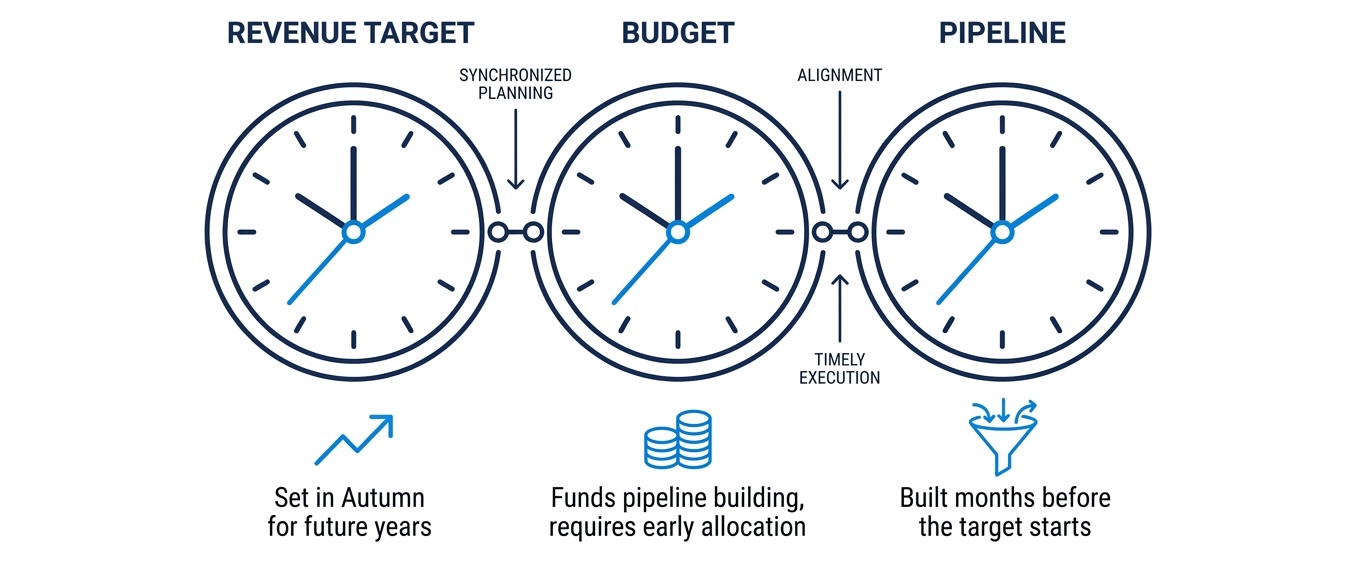
When the number is missed, the story is usually about the team or the market: too little activity, too much discounting, a tougher competitive landscape. All of those can be true. All sit downstream of the real cause.
The cause is that your revenue target, your budget, and your pipeline run on three different clocks that were never synchronized. The revenue target is set in the autumn. For a company with a six-month sales cycle, the pipeline needed for January had to start building in July, months before that target was set. And the marketing and resource budget needed to build that pipeline was fixed well over a year ago, sized to a smaller target and a smaller ambition. The jump-off point the new target requires was never resourced. No one designed it this way. Like most of the commercial system, the three clocks accumulated one reasonable planning decision at a time, for a business that has since changed. We call the wider pattern the Budget Cycle Trap. Sales is where it surfaces, because sales is where the gap lands.
The way out starts with a shift in how you read the revenue target. It is a pipeline requirement to build, worked backward from the number through your own deal economics to the coverage you must hold and the date you must hold it by. It fits on one page.
Two numbers anchor the calculation: your win rate and your cycle length. Your win rate determines the coverage multiple: a 25 percent win rate means four times coverage. Your cycle length determines when that coverage must exist. B2B cycles lengthened by roughly 38 percent during 2022-23 (Ebsta), so the pipeline has to be in place earlier than it used to. Miss that window and no amount of activity in January closes it fully.
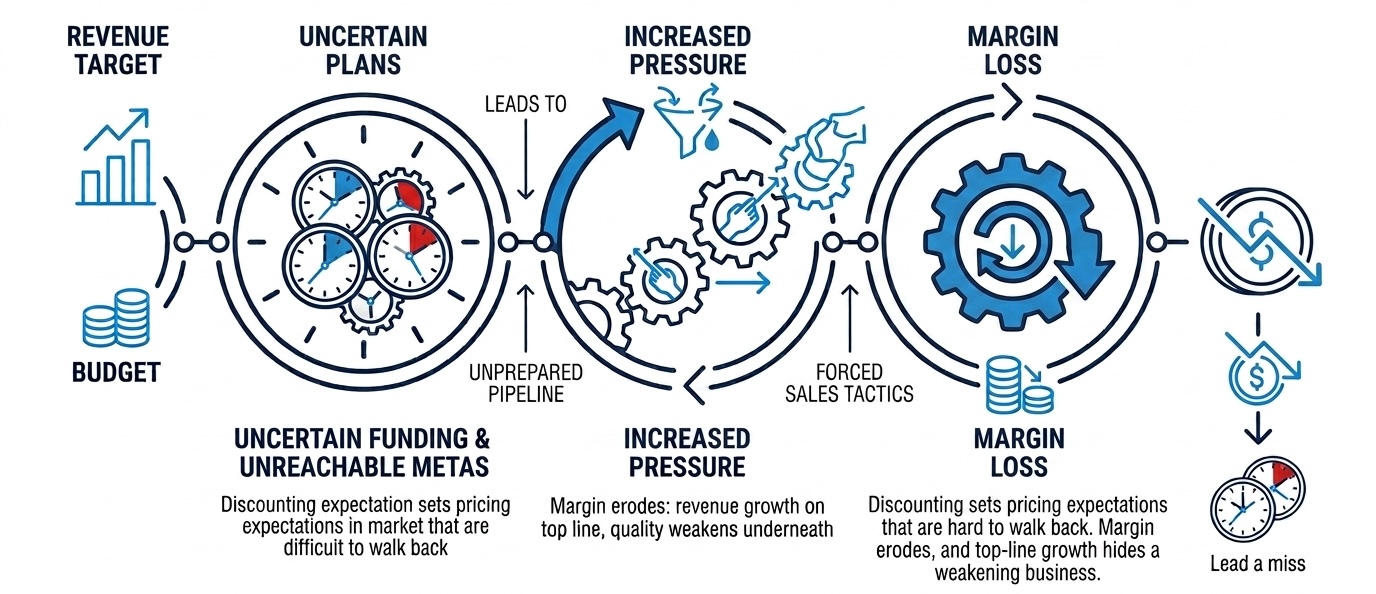
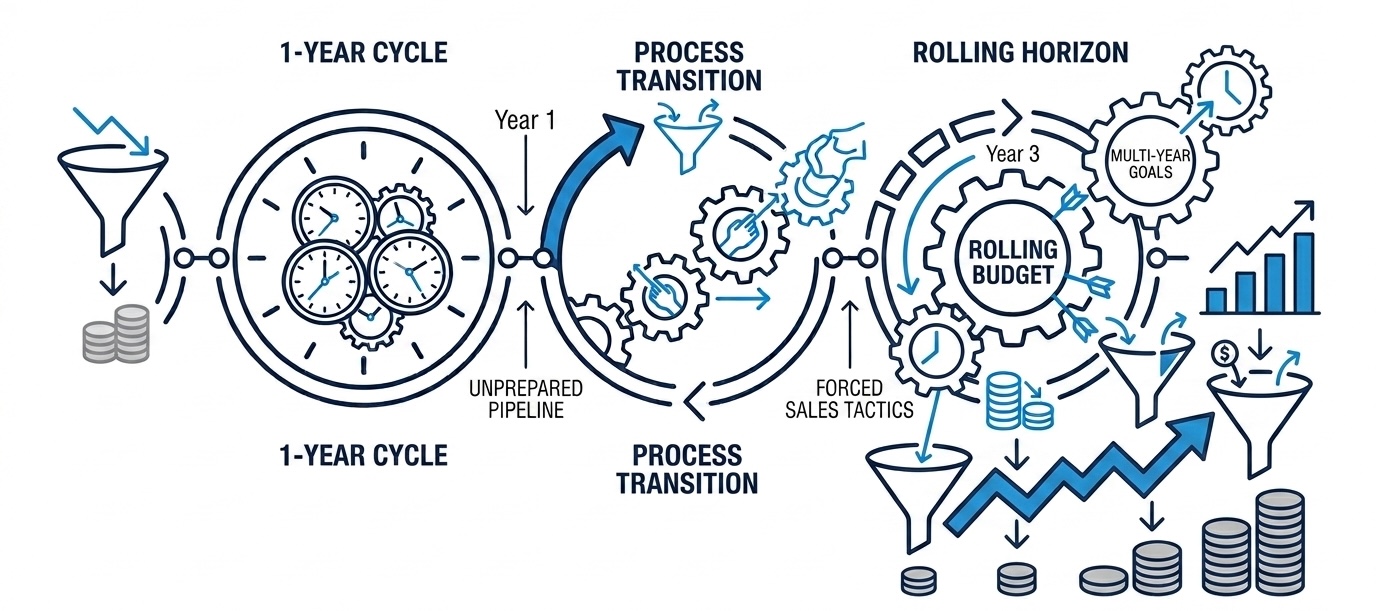
This is where Pipeline Math moves beyond ordinary funnel planning. Building the pipeline that opens next year is only one of two calculations the plan requires. With a long cycle, the revenue that opens the year after next depends on a jump-off point the team has to reach by the end of next year. Plan one year at a time and the year after opens short by definition: its pipeline had to start building inside a plan that was never asked to produce it. The catch-up repeats for the same structural reason, every year.
So the plan runs on a rolling two or three-year horizon, with two calculations rather than one. The first is the pipeline that must exist to open next year. The second is the year-end jump-off point you build for the year after. The first keeps you from starting behind. The second keeps you from doing it again twelve months later. That second calculation is what separates Pipeline Math from ordinary annual planning.
This matters in a second way. When a team spends the year chasing the immediate gap, it underinvests in the pipeline required for the year after. The Budget Cycle Trap creates a repeating pattern: each year’s scramble depletes the pipeline position for the next, and the commercial behaviours that thin pipeline produces, the discounting, the ICP drift, the margin erosion, and the pricing expectations set in the market, all carry forward.
The reverse calculation tells leadership what the revenue target costs at your current conversion economics. That is one half of the plan. The other half is what the team is doing to improve those economics.
A coverage plan that says “the target requires this much pipeline at this win rate, so we need this level of investment” is strengthened when it includes a productivity commitment. The levers are specific: improving win rates through better qualification and deal execution, reducing cycle times by engaging the right stakeholders earlier, increasing average deal size through better value positioning, and improving lead-to-opportunity conversion through tighter alignment with marketing.
Present the baseline: what the target costs at current conversion economics, built on the last twelve months of actual performance. Then present the productivity measures the team is committing to, with the improvement each one targets. The gap between the two shows leadership that the commercial team is working both sides of the equation: the coverage the target requires and the economics that make that coverage deliver more. That is what earns the conversation about resources.
The gap is created in the annual budget cycle, so that is where a sales leader has to intervene. The strongest position starts well before budget season, with the company’s two or three-year growth plan as the foundation.
Get into the plan before the target is set. The strongest position is to bring the coverage and the timeline behind the number to the table in the summer, before budget season opens and while there is still time to build. Turn up with the reverse calculation ready, so the conversation starts from what the target actually requires.
Commit to quarterly milestones and a jump-off point alongside the revenue number. Agree the coverage each quarter must hold and the date it must exist by, plus the year-end level that sets up the year after. Put that in the plan the board signs off, next to the revenue line. A revenue number with no pipeline plan behind it is only half a plan.
Put the coverage into one shared model with finance. Bring the required pipeline, its timing, your conversion assumptions, and the cost to build it into a single model. Leadership can then decide with the consequence in view: change the target, improve conversion, adjust the mix, or accept the gap knowingly. Finance becomes the partner that turns a coverage plan into a funded one.
Review and reallocate every quarter. Check actual pipeline against each milestone while there is still time to affect the revenue period it feeds. A gap found early is a reallocation. The same gap found late is a miss. Refresh your inputs while you are in there. Build the calculation on your last twelve months rather than on memory. This also protects the marketing investment: when leadership can see pipeline building to plan, the mid-year pressure to cut marketing spend to protect margin loses its basis.
Do this and the January kickoff changes character. You walk in holding the coverage the plan called for, built on a timeline that matches how your deals really close, rather than being handed a gap to chase.
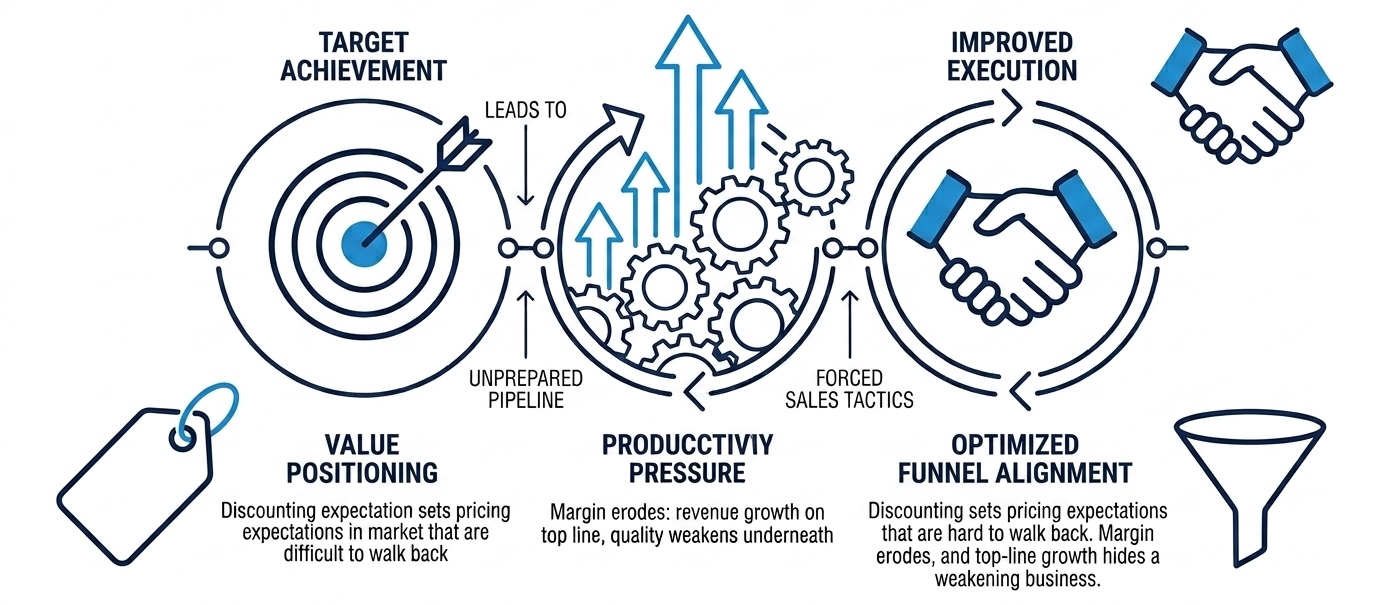
This builds one half of the plan: the coverage and timing the target requires. Turning that required pipeline into a funded, defendable budget is the other half, the one your marketing counterpart owns.
Pipeline Math is where the two meet. It works the target backward through measured win rates and cycle timing, sets quarterly milestones and a year-end jump-off point, turns the required pipeline into a defendable budget, plans across a two or three-year horizon, reviews and reallocates each quarter while it can still change the outcome, and brings strategy, finance, sales and marketing into one plan.
This is one of the Sprints we run with your team, so the discipline stays after we leave. The sprint typically runs in a few weeks and produces a pipeline model the CRO and the CFO can defend and the commercial team can execute against.
Why does sales always start the year behind on pipeline?
Because the revenue target, the marketing budget, and the sales pipeline run on three different clocks. The target is set in the autumn, but the pipeline needed for January had to start building months earlier, and the budget to build it was fixed a year ago for a smaller ambition. Sales inherits the gap those unsynchronized clocks created.
How much pipeline coverage do I need to hit next year’s revenue target?
Divide the revenue target by average deal size for the deals to win, then by win rate for the qualified opportunities to create. Your win rate determines the multiple: a 25 percent win rate means four times coverage. Your cycle length determines when it must exist. Then add the year-end coverage position the following year’s target requires.
How far ahead should I be planning pipeline?
If your deal cycle runs six months or longer, you are into multi-year planning. Pipeline Math plans on a rolling two or three-year horizon: the pipeline to open next year, and the year-end jump-off point for the year after.
What can a sales leader do if the target is set without them?
Get ahead of the budget cycle. Model the rolling coverage requirement against the company’s two or three-year growth plan before budget season opens, and bring pipeline milestones and jump-off points into regular business reviews. When the coverage model is already running and leadership is aligned on what the target requires, the annual target conversation starts from a position of strength.
The Quick Scan maps your company against the commercial system and shows your highest-impact gaps, including whether your target, pipeline and budget are running on the same clock. Two minutes, no email required, no salesperson involved
→ Find your commercial leaks: https://commercialsprints.com/quick-scan
Prefer to talk it through first? Book a 30-minute call with Rob directly: https://bit.ly/book-a-30-minute-call