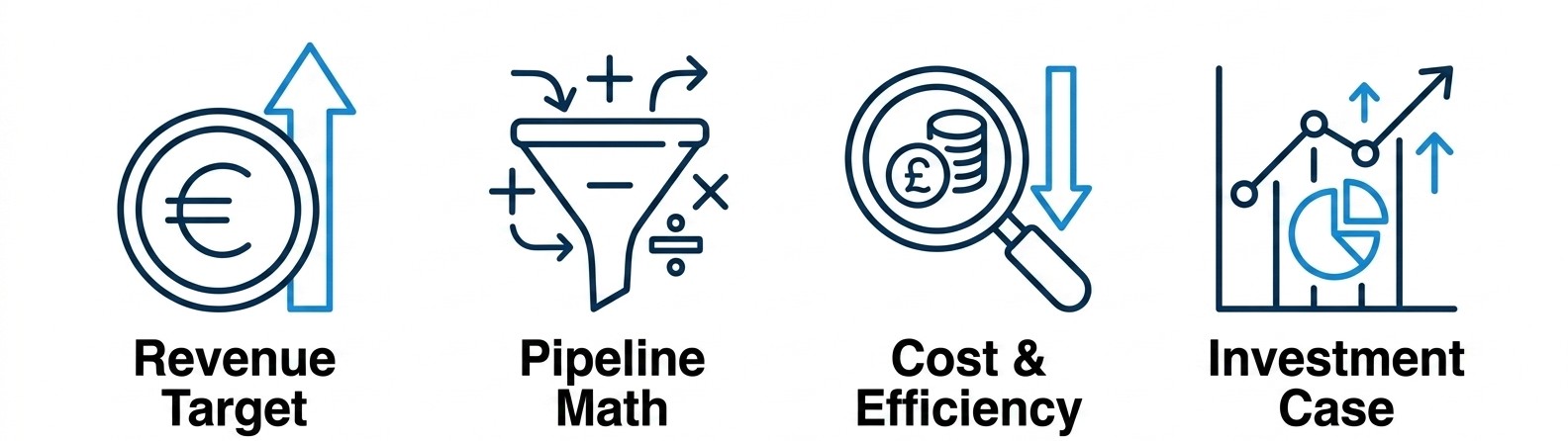
Your revenue target has a price in pipeline, timing, and marketing investment. Build it backward from the number. The budget case gets much harder to argue against.
Budget season puts most marketing leaders in the same position. You are asked to plan next year’s spend and make the case for it, while 64 percent of marketing leaders say they do not have the budget to execute their strategy (Gartner, 2024 CMO survey). The reflex is to fight for more or accept less and adjust scope. Both responses miss the stronger move: turn next year’s revenue target into the investment it requires, then put that in front of leadership as one model with the consequence in view.
Framed that way, the budget reads as the price of the target rather than marketing’s ask. From there, the options are clear: fund the target as calculated, adjust the growth expectation, change the commercial mix, or accept the gap knowingly. The decision becomes executive leadership’s to make with both sides visible.
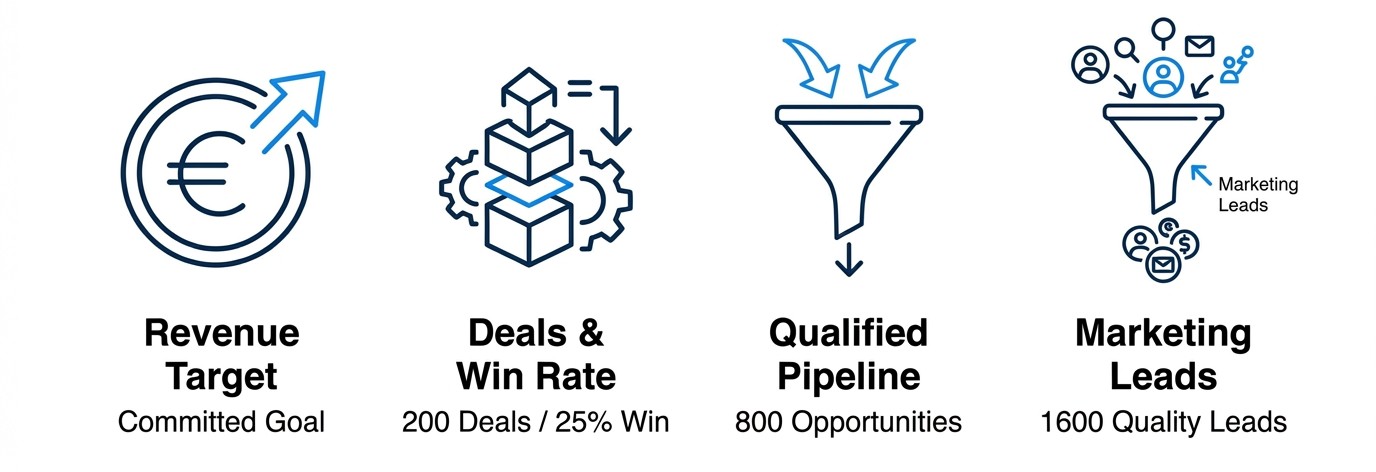
Start by building the budget backward from the revenue target instead of forward from last year. Take the number, work back to the pipeline it requires, then take marketing’s agreed share and cost the programmes that produce it. This is Pipeline Math. It fits on one page.
The budget now follows from the target. Trim it and the model shows the real cost: a lower target or a later one. Leadership can still choose to trim, now with that trade-off in view.
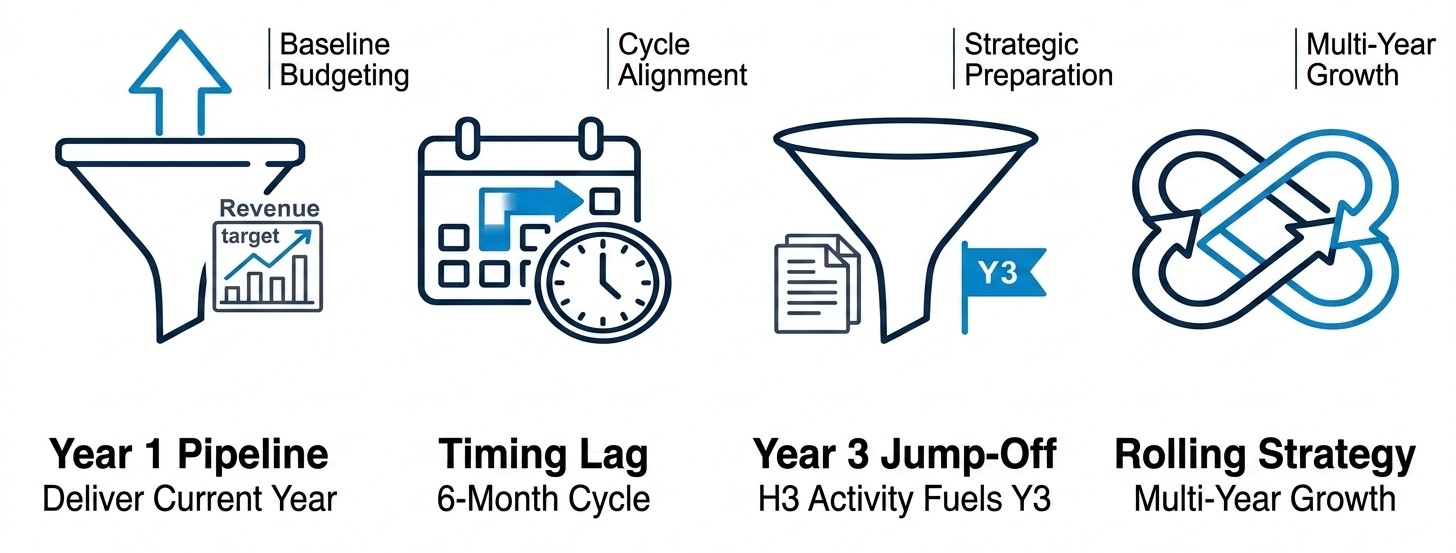
Here is where most marketing budget models fall short. The fiscal-year marketing budget needs to aim at two targets: the pipeline required to deliver the budget year’s revenue and the year-end pipeline position the following year’s target requires.
This works best when the company maintains a rolling two or three-year growth plan. Both the sales director and the marketing director should know what the target is for the year after, because the reverse calculation for marketing activity and spend depends on it. If the company has an approved two or three-year plan, the marketing investment case can cover both revenue years in a single model. If it does not, put in a planning assumption. Take next year’s approved target, apply an assumed growth rate for the year after, and reverse-calculate the pipeline entries that need to be generated in the second half of the budget year to support it.
When you present the investment case to the finance director and the managing director, that assumption is visible: “We took next year’s revenue target and calculated backward from pipeline to leads to programmes. We also took a planning assumption of continued growth for the year after, so we know how many new pipeline entries we need to generate in the second half of the budget year. The marketing budget is an investment case for both of those results.” Finance can challenge the assumption, adjust the growth rate, or approve it. Either way, the consequence is in view and the budget is built on a plan that extends beyond twelve months.
Keep this as a rolling model you update as targets are refined and conversion data comes in. You always have a forward-looking pipeline plan in terms of revenue, opportunities, leads, and the programmes that produce them.
Give finance one model: the target, the timing, the conversion, the cost, and the productivity that stretches the investment further each year.
The reverse calculation tells leadership what the target costs at your current conversion economics. That is half the investment case. The other half is what you and the team are doing to improve those economics.
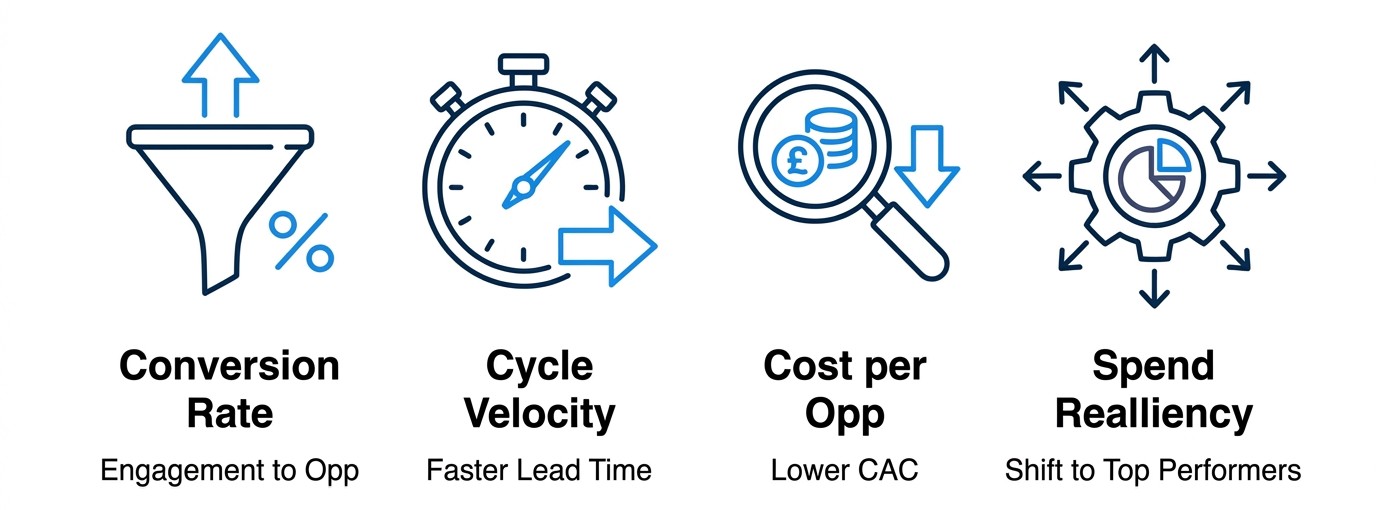
A budget case that says “the target requires this much pipeline, every lead costs this, so we need this budget” will meet resistance. Executive leadership expects higher returns from an increased budget, returns that go beyond absorbing inflation. The investment case needs a productivity improvement component that shows how marketing is working to deliver more pipeline per euro spent.
The levers are specific: improving conversion rates from engagement to qualified opportunity, shortening the time from first content interaction to lead, lowering the cost per qualified opportunity, reallocating spend from programmes that underperform to ones that convert, better reuse and distribution of content, and improving conversion on existing website traffic. Each of these is measurable, and each belongs in the plan.
Present the baseline: what the target costs at current conversion economics, built on your last twelve months of actual performance. Then present the productivity measures you are committing to, with the improvement each one targets. The gap between the two is the efficiency story. It shows executive leadership that marketing has a plan to absorb inflation and improve returns through better execution rather than through a larger budget alone.
This is what convinces executive leadership that the investment case is sound: a plan where the target drives the number, and the team drives the economics.
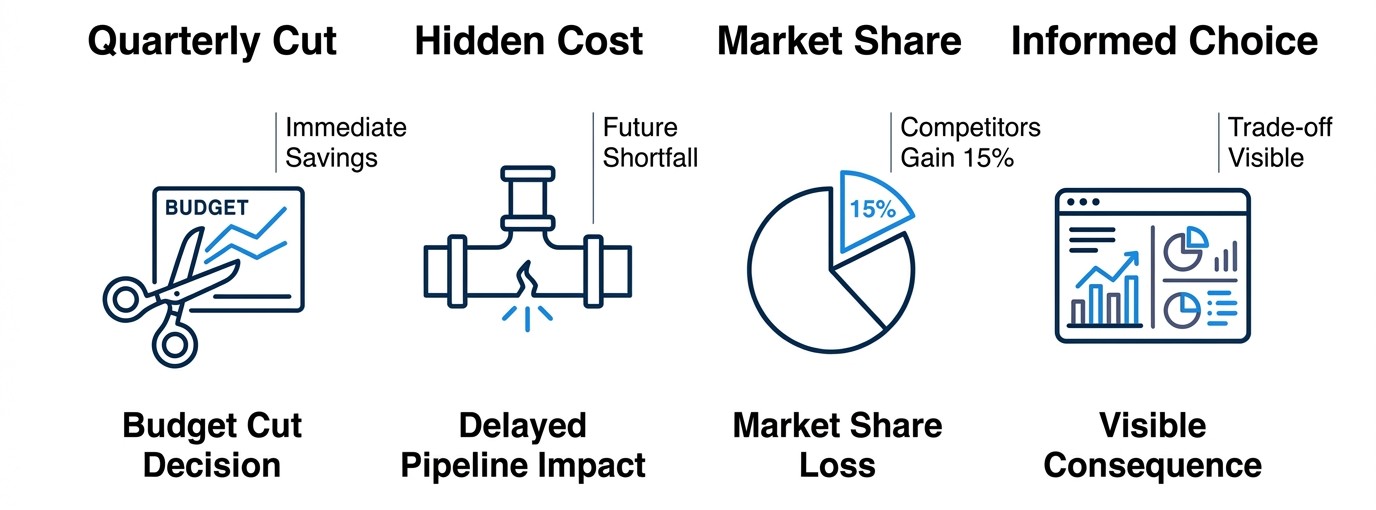
Before making that case, understand what you are walking into. When a year underdelivers, leadership has to protect margin, cash flow, the expectations of owners or a board, and, where relevant, the company’s ability to meet its banking covenants. Marketing is one of the few discretionary budgets that can be adjusted quickly without immediate operational disruption, which means it is often reduced before the company reaches headcount reductions or structural changes. There is no failure of nerve in that. Leadership is responding sensibly to the information in front of it at the moment of the decision.
The problem is the information in the room at that moment. The cut is usually made without the one number that should inform it: what it does to the pipeline opening next year and the year after. Once that number is visible, trimming marketing may well still be the right call. Made without it, the consequence only becomes visible when the pipeline opens short the following year.
Commercial investment builds pipeline on a delay. The spend you protect or cut this year shows up in the pipeline that opens next year, then in the jump-off point for the year after. The savings land this quarter, in a number everyone is watching. The cost lands next year, in a period few people are looking at yet. Companies that cut marketing investment under pressure risk handing up to 15 percent of their business to competitors who keep investing (Analytic Partners).
Marketing may well still be the right line to trim. The point is that the future consequence belongs on the table before the decision, so the trade-off is made with both sides in view. The investment case you build with Pipeline Math is what puts that consequence on the table.
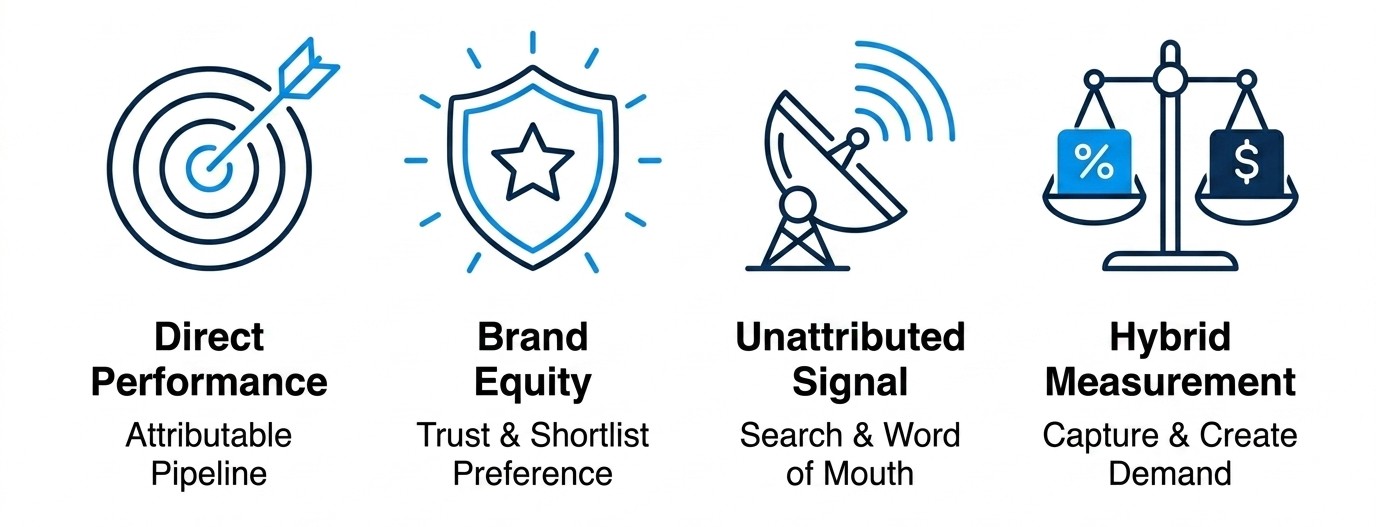
One caution on the model. A large portion of the marketing investment should produce marketing-attributed pipeline: leads and opportunities you can trace back to specific marketing activities. This is demand you capture, and it is the easiest return to defend. Direct attribution captures a shrinking share of marketing’s real contribution. Privacy regulations and AI-powered search are steadily reducing the signal attribution models depend on. What falls outside that signal is brand marketing: being known, trusted, and preferred before a buying process begins. It affects shortlist inclusion, conversion rates, win rates, and pricing resilience. It is what makes future pipeline cheaper to generate and quicker to close. Measure it through branded search, direct traffic, shortlist rates, and price resilience. Fund only what is directly attributable and you quietly starve the demand that opens future years.
So the investment case carries two returns. One is the pipeline marketing captures next year, attributable and measurable now. The other is the brand marketing that creates demand for the years after. A model that holds both, names which is which, and states how each will be measured gives executive leadership something to plan against. Part of the marketing budget must be earmarked for brand marketing, with an explicit purpose, a time horizon, evidence points, and a review date.
Run the model honestly and the answer is sometimes a smaller number, spent differently. The reverse calculation shows which spend traces to pipeline and future demand and which does not, so it makes the case for cutting what underperforms as clearly as the case for protecting what delivers.
That is what turns a budget request into an investment case. When finance sees a model where the underperforming spend has already been cut, the remaining lines are easier to defend. The marketing leader who does that work before walking into the room is the one finance treats as a planning partner.
This builds one half of the plan: the investment the revenue target requires and the productivity that stretches it, across both revenue years it serves. Defining the coverage and timing that target demands is the other half, the one your sales counterpart owns.
Pipeline Math is the plan that joins them. It works the target backward through measured win rates and cycle timing, sets quarterly milestones and a year-end jump-off point, turns the required pipeline into a defendable budget, plans across a two or three-year horizon, reviews and reallocates each quarter while it can still change the outcome, and brings strategy, finance, sales and marketing into one plan.
This is one of the Sprints we run with your team, so the discipline stays after we leave. We build the investment case with finance, rather than against it. The sprint typically runs in a few weeks and produces a pipeline model the CRO and the CFO can defend and the commercial team can execute against.
Marketing is one of the few discretionary budgets that can be adjusted without immediate operational disruption, and its return arrives later. The cost is that the same spend builds next year’s pipeline, so the saving lands this quarter while the shortfall surfaces in a future period no one is watching yet. Make that consequence visible before the decision, so a cut is a conscious business choice.
Build it backward from the revenue target through win rate and cycle length to the pipeline that must exist, take marketing’s agreed share, and cost the programmes that produce it. Include the year-end pipeline position the year after requires and the productivity measures that improve the economics. Give finance one model with the target, timing, conversion, cost, and productivity together.
Attribution sees less than it used to. Brand marketing, being known, trusted, and preferred before a buying process begins, affects shortlist inclusion, win rates, and pricing resilience. Earmark a defined portion of the budget for it, measure through branded search, direct traffic, and price resilience, and give it stated objectives and a review date.
Sometimes smaller. Building the budget backward from the target shows which spend traces to pipeline and future demand and which does not. A model that has already reallocated away from what underperforms is one finance can trust.
The Quick Scan maps your company against the commercial system and shows your highest-impact gaps, including whether your target, pipeline and budget are running on the same clock. Two minutes, no email required, no salesperson involved
→ Find your commercial leaks: https://commercialsprints.com/quick-scan
Prefer to talk it through first? Book a 30-minute call with Rob directly: https://bit.ly/book-a-30-minute-call