
.png)

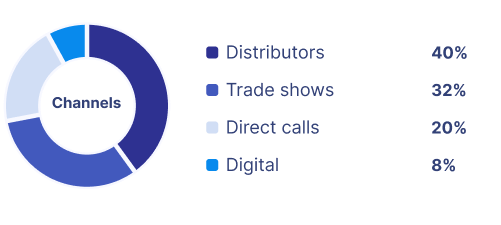
The distributors still call and the trade shows still fill, so the route feels proven. But it was built for how buyers used to buy, and a third of the journey now runs through channels your route never touches.
.png)
Opportunities reach you as RFQs with the specification already written. By the time you engage, the criteria favor whoever shaped them first, and price is the only lever you have left.
.png)
A growing share of your market does most of its research before contacting any supplier, and many would rather not involve a rep at all. If your route only kicks in once someone asks for a call, it misses the part of the journey where the decision is actually made.
.avif)
The channels that delivered for years feel proven, so the response to softer results is more effort through the same routes, more reps, more trade shows, more outreach. But buyers have changed how they research, what they weigh, and what sets them off, and the route was built for the old pattern. Pushing harder on a channel the journey has moved past just raises the cost of the same result.
.png)
Roughly a third of that journey now happens in person, a third remotely, and a third through digital self-serve. A route built mainly for one of them is missing two-thirds of how buyers buy, no matter how strong the relationships inside it.
The channels were built for how buyers bought ten-twenty years ago. The journey moved to a multi-channel, pre-contact path, and the route stayed where it was.
The decision now forms early, in the research stage, where no one from your model is present. The channels you do have are busy fulfilling choices the buyer has already made.
Deals reach you as written RFQs, after the criteria are already set. The supplier who got in first shaped the criteria, and you spend the deal trying to turn a decision already tilting their way.
Every channel and intermediary between you and the buyer can strip the value narrative down to specification and price. By the time it lands, the reason to choose you is gone.

We map how your buyers actually discover, evaluate, and decide today, per segment. Then we test every channel and partner against that journey, sorting the ones that shape the buyer's decision from the ones that only take and deliver the order.

We rebuild the route where it misses the buyer or dilutes the message, and add a self-serve layer for the parts of the journey buyers prefer to run without a rep. Every route carries a cost and a conversion rate, so design decisions are made with numbers.

Your team owns a route map scored against how buyers actually buy. It marks where to show up earlier in the journey and the stages your sales process should mirror, so the redesign holds after we leave.

How your buyers actually discover and decide today, mapped per segment rather than assumed from how the route was designed.
Every channel, role, and intermediary tested against that journey, with a self-serve layer for the parts buyers prefer to research without a rep.
Whether your value narrative survives end to end, or dilutes into specification and price before it reaches the buyer.
Cost and conversion for every route, so you stop paying influence-level margins for fulfillment-level work.
The 2-minute diagnostic maps your company against all twelve sprints and shows where Buyer Precision fits in your priorities.
.webp)
Drawn from McKinsey's Global B2B Pulse, roughly 3,800 decision-makers.
Buyers now run their journey across ten channels, split evenly across in-person, remote, and digital self-serve, and the companies that built for all of it pulled ahead. The winners did not abandon their channels. They redrew the roles, deciding which ones influence the decision and which only fulfill the order, and staffed the early stage the old model left empty. The ones that leaned hardest on the traditional model reported the lowest satisfaction with their own sales performance.
of companies selling through seven or more channels grew or held market share.
of B2B buyers prefer a rep-free experience, yet fully self-serve buyers report markedly higher purchase regret. The route that wins blends self-serve access with expert guidance where it counts.
of decision-makers would switch suppliers after a poor experience across your channels, where information is inconsistent or they can’t get a knowledgeable answer.
Sales Process turns the journey you mapped into the way every deal runs, so opportunities advance on evidence and the forecast becomes a calculation.

Digital Dominance gets you found where buyers research and build their shortlists, in search, communities, and AI answers, before they ever make contact.
The next step is a 30-minute conversation where we assess whether Buyer Reach and Access is the right starting point for your business.

.svg)