
.png)

Your pipeline looks healthy, then opportunities stall and go quiet. They go quiet rather than to a rival, because the case for change never got sharp enough to act on.
.png)
Buyers cannot tell your value from the next supplier's, so the conversation drifts to price. When difference disappears, discount becomes the only lever left in the room.
.png)
The offering is genuinely differentiated and the interest is real, yet none of it turns into orders. Every deal stalls on the same unspoken question, why change what already works?

In complex B2B, the deal most often dies to the status quo. The value proposition exists on the website and in the PowerPoint deck, so the box feels ticked. No one tests whether a buyer could repeat it, tell it apart from a competitor's page, or use it to justify a decision internally, which is the only work a value proposition has.
.avif)
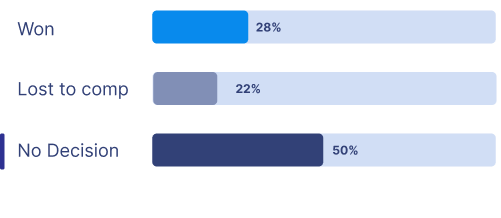
Across 2.5 million recorded sales conversations, more deals died to hesitation than to any competitor. The buyer saw potential value and still chose the safety of standing still, because the cost of doing nothing was never made concrete in their own numbers.
A value proposition exists on the website, so the work feels done. No one tests whether a buyer could repeat it or use it to justify a decision internally, which is the only work it has.
Every competitor claims the same outcomes, so buyers cannot tell suppliers apart. When difference disappears, the conversation defaults to price.
Teams sell against rivals while the real competitor, the status quo, goes unaddressed. Nobody quantifies what standing still actually costs the buyer.
The team describes what the product does and leaves the buyer to translate it into business impact. Buyers rarely make that translation, so the case for change never lands.

We re-code last quarter's lost deals into two columns, lost to a competitor and lost to no decision. The second column is usually larger, and we trace why the case for change failed to land.

We build the claim architecture, attach verified proof to every claim, and quantify the cost of inaction in the buyer's own numbers. Standing still becomes the expensive option.

Your team owns one narrative carried identically from website to proposal to live conversation. We equip sellers to frame the status quo first, before any competitor enters the room.

A structured set of value claims, each grounded in what your best buyers actually care about, that a buyer can repeat and use internally.
What staying put costs the buyer, quantified in their own numbers, so doing nothing stops being the safe choice.
Verified customer outcomes attached to every claim, so value is demonstrated rather than asserted.
One narrative carried identically from website to proposal to conversation, so the message holds wherever the buyer meets it.
The 2-minute diagnostic maps your company against all twelve sprints and shows where Buyer Precision fits in your priorities.
.webp)
Founder-led advanced materials — Genuinely differentiated product, major corporations at the table.
A start-up founder had built a genuinely differentiated raw material, drew national media attention on television and in print, and within weeks major corporations were calling. Eighteen months later there were still no orders. Large corporations sent teams to learn, pilots ran with no committed criteria or timelines, and every deal stalled, then went quiet. Nothing made standing still more expensive than the risk of changing. Buyer-Decisive Value built the case for change and quantified the cost of inaction in the buyer's own numbers.
On the strength of that case, the company secured a renewed capital injection.
orders in eighteen months of active corporate interest, because nothing made standing still more expensive than changing.
of B2B providers have a value proposition buyers rate as truly differentiated, and those few grow 1.6x faster than the rest.
of buyers see enough difference between suppliers to pay for it. The rest default to price, which is where an untested value case leaves you.
Your value narrative only works if it reaches the right buyer intact. This sprint pressure-tests whether your route to market carries it end to end.

Sales Process puts your cost-of-inaction case into the business case for every deal, so opportunities advance on evidence.
The next step is a 30-minute conversation where we assess whether Buyer-Decisive Value is the right starting point for your business.


.svg)