
.png)

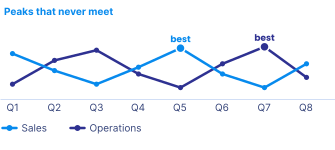
When sales is flying, operations is firefighting. When operations runs clean, the sales volume is not there. The two best quarters almost never land in the same one.
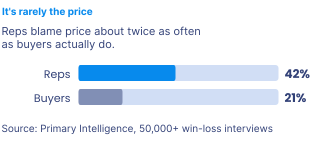
The market softened, a competitor cut price, a budget froze, or operations fell short on lead time and quality. Reps blame price about twice as often as buyers actually do (source: Primary Intelligence, 50,000+ win-loss interviews). The miss gets filed under tough market conditions and the company waits, instead of fixing what it could.
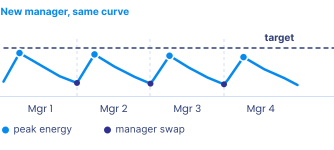
When results disappoint, the company swaps the sales manager. The new one arrives with energy, fades within two years, and leaves the same question behind.

Three-quarters of a point of quarter-end price drift costs €150,000 a year without a single approved decision, and roughly a quarter of everything the first eleven sprints recovered leaks back out every year. What this sprint protects is everything the first eleven won.
Sales was never given a system of its own, and never built one. What it got was a number to hit and a meeting to explain it in, with nothing underneath to improve.
When the numbers slip, the team meets weekly instead of monthly. They look at the same figures more often, rarely deeper and rarely from a new angle. The miss gets named again, the team pushed harder to do better.
The vagueness is convenient. As long as no one can see why deals land or slip, the forecast stays soft and any miss can be put on the market rather than on a decision someone could have made. Sales gains the most from being hard to read, so it stays hard to read.
Although the stages in your CRM may fool you, most salespeople follow no defined process at all, so results ride on instinct and the strongest reps. When the quarter disappoints, no one can point to the step that broke.

We read your last four sales reviews and count the decisions that changed what the team did next, usually zero, and the sales managers the company has had in ten years, usually three or more. Then we map what the earlier sprints installed, the customer, the value, the route, the stages, the math, so the system runs on what you already own.

We put one operating system around all of it, a weekly deal review, a monthly performance review, and a quarterly recalibration, each run from a single dashboard or presentation pack built on the KPIs the earlier sprints defined, stage conversion, cycle time, win rate, discount depth. Every meeting ends in logged decisions.

The cadence runs in about two hours a week. Every gap to target gets addressed, and every result above target gets boosted. What the earlier sprints built keeps improving instead of eroding, and your sales manager can finally answer the question from the top of this page.
The 2-minute diagnostic maps your company against all twelve sprints and shows where the Post-Sale Potential Sprint fits in your priorities.
A weekly evidence-based deal review, a monthly performance review, and a quarterly refresh, each run from one dashboard or presentation pack and each ending in logged decisions, so the meeting changes what happens next.
The discipline operations already runs, pointed at revenue, volume, margin, conversion and cycle times. Every gap to target gets a root cause and the countermeasures to close it. Every result above target gets the same read and boosting measures to push it further, each with an owner and dates, so you discern what to fix and what to fund harder.
Three checks before the discount question even comes up. Is this the right customer, is the deal healthy enough to pursue, and does the price hold. Wrong-fit or stalled deals get parked rather than discounted into the forecast. A discount-authority matrix, margin visibility before commitment, and quarter-end rules handle the rest, with every exception logged.
Each quarter the work the earlier sprints installed is checked against fresh win-loss evidence and tuned, the ideal customer, the value proposition, the route, and the funnel stages. And the scorecard, one page of capture rate, win rate, discount depth, and forecast accuracy, stays with the job rather than the person.


Sales becomes a function you can read, direct, and trust, the way you already read operations. Results stop depending on whoever is managing this quarter, the plan behind the number is visible and open to challenge, and everything the first eleven sprints won stops leaking away. The most obscure function in the business becomes one you can actually run.
of salespeople follow no defined sales process at all. Running on a target and a meeting is what leaves results depending on the manager (Objective Management Group).
is the average tenure of the senior sales leader, less than a third of a CEO's. The replacement reflex, measured.
of companies can quickly redirect a failing initiative. In the rest, the meeting reports and nothing changes course.
Revenue Intelligence starts the cycle again each year, decomposing the business so the operating system always points at where the profit really is.

Sales Process is the engine this operating system runs and protects, the stages and evidence the weekly review is built on.
The next step is a 30-minute conversation where we assess whether Commercial Operating Discipline is the right starting point for your business.


.svg)